
Ready to begin your immigration journey?
Let’s get started by planning the first steps together now.Meet Our Team

New Zealand’s Active Investor Plus (AIP) Visa, the country’s revamped “Golden Visa” programme, has continued its momentum into 2026, reinforcing its position as one of the world’s most attractive migrant investor pathways.
As of 19 January 2026, Immigration New Zealand has received 532 AIP applications with 100 applications under the Balanced Category (requiring $10 million to be invested over five years), and the remaining 432 applications under the Growth Category (requiring $5 million investment over three years). Interestingly, the split of around 80% Growth, and 20% Balanced, has been very consistent since the updated policy settings took effect on 1 April 2025.
In total, these applications represent $3.16 billion in potential new investment into New Zealand, of which $926 million has already been invested. While investors under the Balanced Category do have the option to invest in bonds and listed equities, Growth Category applicants can only invest in managed funds and direct investments which are approved by InvestNZ. To become approved, investments must be New Zealand domiciled and must have the potential to tangibly benefit the New Zealand economy. Direct investments must also provide actual evidence of genuine investor interest. Importantly, approval by InvestNZ does not mean the investment is in any way Government-guaranteed and AIP investors must undertake their own due diligence before deciding on any investment.
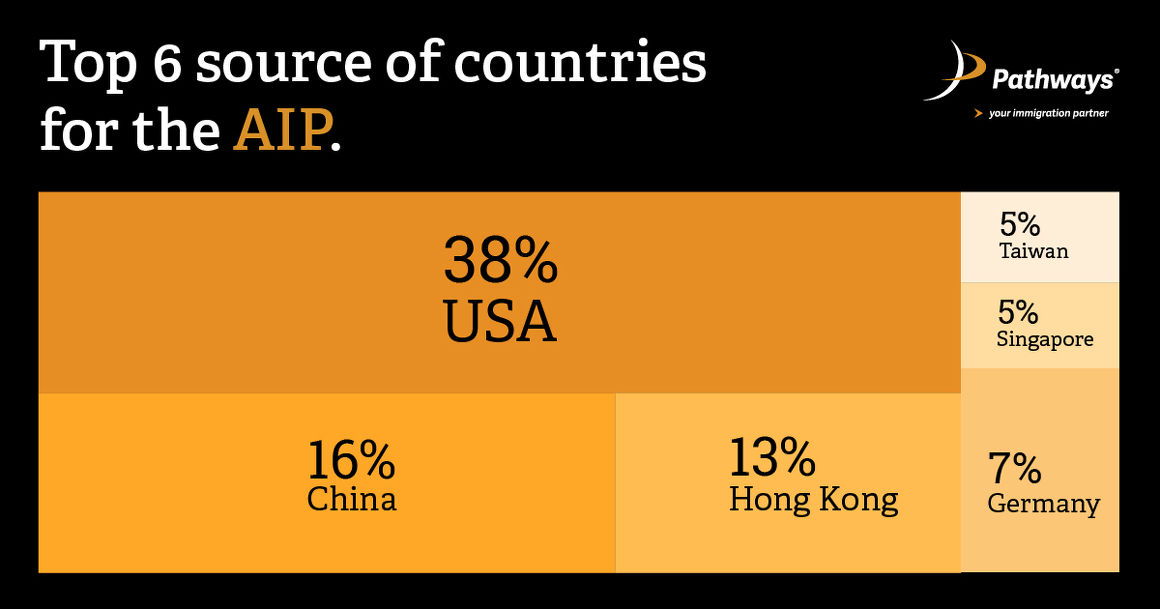
AIP investors now come from 33 countries, led by: USA (38%), China (16%), Hong Kong (13%), Germany (7%), Singapore and Taiwan (both 5%). It is encouraging to see such widespread, and growing, interest from all over the world. Contributing to the attractiveness of the AIP are the reduced time-in-NZ requirements, the permanent residence outcome, the lack of other competing migrant investor policies, and the fast processing times. The average time to approval in principle is 33 working days and once approved in principle, applicants have six months to transfer and invest the required funds.
Applicants have different reasons for choosing the AIP, but mainly it is about having a Plan B. The world is experiencing significant change and uncertainty and applicants are seeking options to provide additional long-term family and financial security, and to open doors to new opportunities. For many, simply moving some of their capital to another country is a sensible financial decision and the resident visa outcome provides an additional incentive to choose the AIP.
The AIP is certainly achieving its core purpose, and much more, but this success has created a new challenge - the availability of attractive, investment‑ready opportunities that have acceptable investment risk and returns. With over $3 billion of potential capital already in the pipeline, and the potential for another $3+ billion during 2026, capital is arriving faster than opportunities are being created. AIP investors are very astute people and expect to be presented with high quality and well-managed investments. To date the private sector has stepped up, and is continuing to step up, with a wide variety of investment options, but it remains to be seen if they can continue to provide the quantum and quality of investments demanded by AIP investors in the future. The AIP also represents an opportunity for the Government to direct some of this capital into, say, much needed infrastructure projects but, somewhat surprisingly, we have not yet seen any appetite for this.
The success of the AIP ultimately rests on proactively building on the progress achieved so far, ensuring that approved applications translate into real investment, and that this capital delivers meaningful, beneficial and long‑term outcomes for New Zealand. While the numbers to date are very encouraging, the real challenge will be whether New Zealand can provide sufficient, high‑quality and sustainable investment opportunities to meet AIP investors’ requirements and expectations – this is something both the private sector and the Government need to deliver upon.
Meet Our Team
We use cookies on our website to provide you with the best experience. If you would like to know more about our privacy policy, take a look at our Privacy Notice